
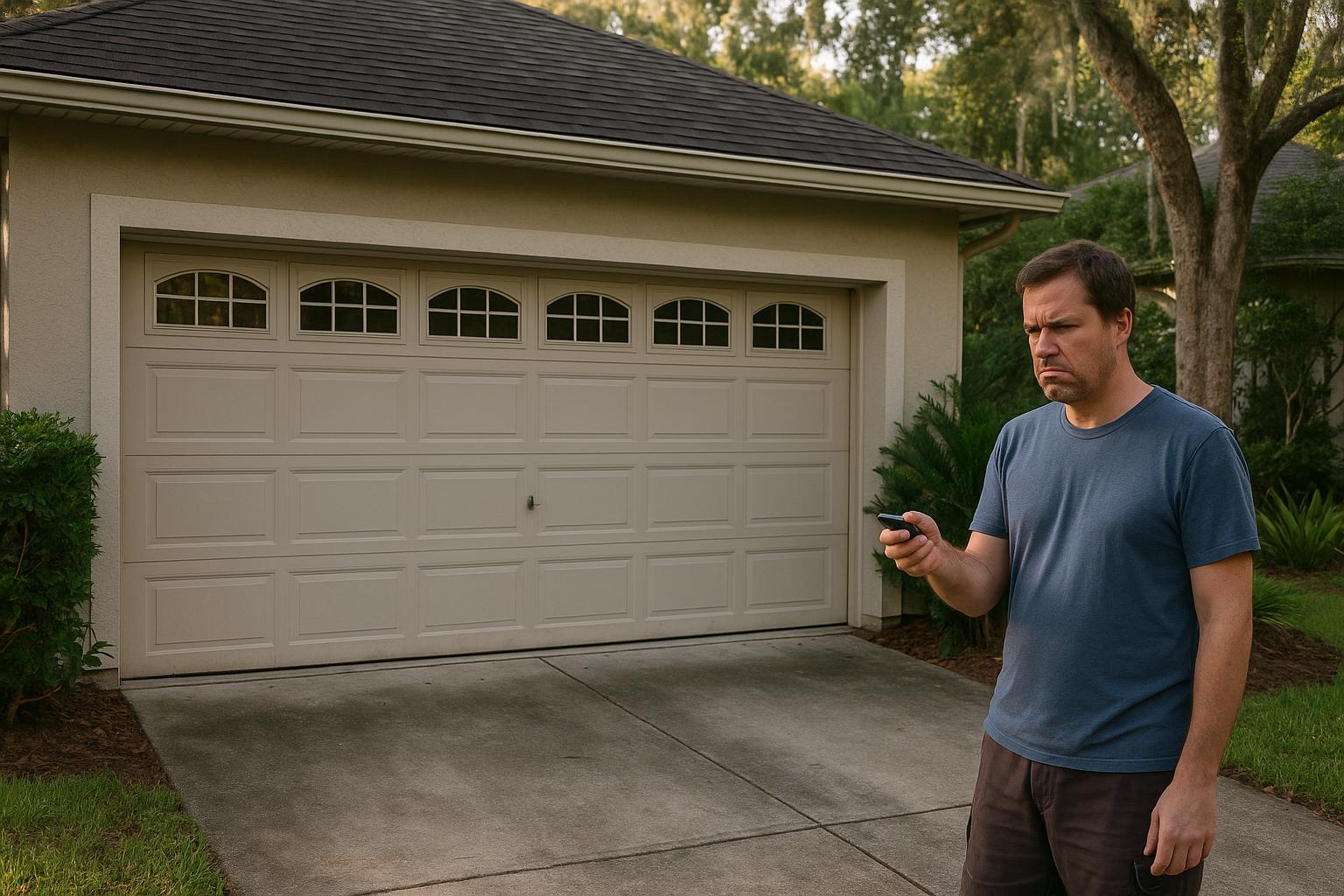
You're Running Late and Your Garage Door Won't Budge
It's 7:30 in the morning, you've got your coffee in hand, the car is loaded up, and you hit the garage door opener. Nothing. Or maybe it groans, clicks, and refuses to move. Few things start your day off worse than a garage door that won't open when you need it most.
This is one of the most common calls we get at Tallahassee Garage Door Co, especially during the cooler months and after particularly cold overnight temperatures. The good news is that not every stuck garage door means an expensive repair. Sometimes the fix is simple enough to handle yourself. Other times, you'll need professional help — but at least you'll know what you're dealing with.
Here's a step-by-step guide to figuring out why your garage door won't open and what to do about it.
Check the Obvious Things First
Before you start worrying about broken parts, rule out the simple stuff:
- Dead remote batteries: This is the number one cause of a garage door that seems unresponsive. Swap in fresh batteries and try again. It sounds too easy, but it solves the problem more often than you'd think.
- The wall switch: Try opening the door from the hardwired button inside the garage. If the wall switch works but the remote doesn't, the issue is with the remote — not the door or opener.
- Power outage or tripped breaker: Check whether the opener unit has power. Look for an illuminated LED on the motor unit. If there's no power, check your electrical panel for a tripped breaker. Storms in Tallahassee can knock out power overnight without you realizing it.
- The lock mode: Some garage door openers have a lock feature that disables the remote. If someone accidentally engaged it, the remote won't work. Check your wall console for a lock button or indicator light.
The Door Is Locked or Manually Disengaged
Older garage doors in the Tallahassee area often have a manual lock — a horizontal bar that slides into tracks on either side of the door. If this lock is engaged, the opener will strain against it and fail to lift the door. You might hear the motor running but the door won't move. Disengage the lock and try again.
Similarly, check whether the emergency release cord has been pulled. This red-handled cord hanging from the opener rail disconnects the door from the opener so you can operate it manually. If it's been pulled — maybe during a previous power outage — the opener will run but the door stays put. To re-engage it, pull the cord back toward the opener and manually slide the trolley until it clicks back into the track.
Temperature-Related Problems
Tallahassee doesn't get brutally cold, but overnight temperatures in the 30s and 40s during winter can cause issues that catch homeowners off guard:
- Contracted metal parts: Metal tracks, springs, and rollers contract slightly in cold weather. This can make the door feel heavier to the opener and cause it to struggle or stall.
- Thickened lubricant: The grease on your springs, rollers, and hinges can thicken in cooler temperatures, adding resistance. A silicone-based garage door lubricant works better in varying temperatures than standard grease.
- Weather seal sticking: The rubber weather seal along the bottom of your door can stick to the garage floor when moisture freezes or when humidity causes the seal to bond to concrete. Gently breaking the seal free — don't force the opener to do it — usually solves this.
Listen to What the Opener Is Telling You
The sounds your garage door opener makes (or doesn't make) when you press the button can tell you a lot about what's wrong:
You hear the motor running but the door doesn't move
This usually means the door is disconnected from the opener (emergency release), the drive gear inside the opener is stripped, or the door is locked or obstructed. Check the release cord and manual lock first.
You hear a clicking sound but nothing else
A clicking noise from the opener often indicates a problem with the circuit board or capacitor. This typically requires professional repair or opener replacement.
Complete silence
No sound at all points to a power issue. Check the outlet, breaker, and any GFCI outlets in the garage that may have tripped.
A loud bang followed by the door not opening
If you heard a loud bang — like a gunshot — sometime before the door stopped working, a torsion spring almost certainly broke. This is the most common mechanical failure that prevents a garage door from opening, and it requires professional spring replacement. Do not attempt to open the door manually or repair the spring yourself. Torsion springs are under extreme tension and can cause serious injury.
When the Photo Eye Sensors Are the Problem
The safety sensors near the bottom of your garage door tracks are designed to prevent the door from closing on a person, pet, or object. While they typically affect closing rather than opening, misaligned or malfunctioning sensors can sometimes prevent the opener from operating at all, depending on the model.
Check that both sensor lights are lit — usually one is green and one is amber. If one is blinking or off, clean the lens with a soft cloth and make sure nothing is blocking the beam. Gently adjust the sensor bracket until the light holds steady.
What You Can Safely Do Yourself
Here's a quick summary of what's safe to troubleshoot on your own:
- Replace remote batteries
- Check and reset the breaker or GFCI outlet
- Disengage the manual lock
- Re-engage the emergency release trolley
- Clean and align photo eye sensors
- Apply silicone-based lubricant to rollers, hinges, and springs
- Gently free a stuck weather seal from the floor
What Requires a Professional
Some repairs are dangerous or require specialized tools and knowledge. Call a professional for:
- Broken torsion or extension springs: These are under high tension and can cause severe injury if handled incorrectly.
- Stripped opener gears or failed circuit boards: Internal opener repairs require disassembly and replacement parts specific to your model.
- Cables that have come off the drums: Garage door cables work in conjunction with the springs. If a cable has snapped or slipped off, the door can be unbalanced and dangerous.
- Bent or damaged tracks: A misaligned track can bind the door and cause the opener to fail. Forcing it can make the problem worse.
Don't Let a Stuck Door Ruin Your Morning
A garage door that won't open is stressful, but most of the time the cause is identifiable and fixable. Start with the simple checks — batteries, power, locks — before assuming the worst. And if you've gone through the troubleshooting steps and the door still won't cooperate, don't force it.
At Tallahassee Garage Door Co, we offer prompt garage door repair service across Tallahassee, Midway, Crawfordville, Quincy, and the surrounding areas. When your morning goes sideways because of a stuck garage door, give us a call. We'll diagnose the problem, explain your options, and get your door working again so you can get on with your day.